Ok, so a few days ago I posted a question about Islandwalk and powering X's when the word on the text specifically says "Forests" instead of {G} which would be the Oracle programming text for Forest based manna.
While playing with another returning player he told me that it just looked for the mana symbol and didn't really mean "forests" it really meant "tree in a green circle". I didn't trust him but I accepted it at the casual kitchen table game thinking "another farking thing that they could have just actually used the symbol for instead of using an actual word that seems specific but apparently isn't" quickly followed by " why would they do that? what if he's wrong?"
See back in the day you had to actually parse the text - we used to call Magic "the Editor's Game", If the thing wanted to base stuff of forests you control it looked for forests, not green mana it would say "green mana sources" if it wanted to count that for X.
Then at the Local Gaming Store (LGS*) I was playing casually with a very different kind of returning player and he brought out something with Islandwalk while I was playing Drowned Catacombs and the question came up as to whether or not that was an Island - he called over a friend who played regularly ( and was the teacher who ran his school's competitve debate club) who looked at the board state and told us that no, it was not an Island, you needed a regular Island for Islandwalk. Well this is a guy that I'd seen around the LGS a bit and had been described as "practically a judge" and who was not returning but had been playing many of the years I wasn't. Certainly a "higher level of trust" than Deputy Dog.
It changed the next game completely - because I simply didn't use Islands, but did manage to get one blue manna out - I could have played the same strategy but I would have used more card searching to get out my Manalith when I found out the truth.
Which is this; Nearly-Judge-Debator Guy was wrong and Deputy Dog is at least correct for some of the cards. I found this out because I could not sleep and found everything I could read stressful, including the insider analysis of Worlds because it's not really written with anything other than insider fans in mind and usually served up with a nice slice of elitism, or just cluelessness that making pronouncements about general player tendencies and ranking them is inherently divisive and not understanding why they offended someone.
I am still looking for something that is literally newb friendly and written accessibly, maybe even with some actual instructional design applied to it . . . . but failing to find that I realized that there was an FAQ for Innistrad and found the page of all FAQs for Magic here:
And it was only by reading them one after the other that I realized how some of the rules actually worked - and that they were actually problematic rules because if they were intutive they wouldn't need to be in an FAQ now would they?
If I had looked up the rules notes on the cards themselves using my prefered method of the iPad app that holds all the tournament rules, each card was an individual case and I wouldn't necessarily assume that the rule carried over universally - after all it had a note on it right?
Well that was wrong - I found out about the Islandwalk rule because going throught the FAQ for 2012 and reading the FAQs for Innistrad helped me understand some really important things if I was going to be able to really use cards strategically. Like the card specific notes on this :
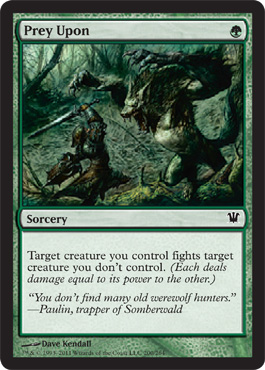
Fight is one of those things that confuse me when they're played against me - I'm never sure about how instants work and damage and healing and where the heck does it count in combat since it's a sorcery that I usually find cast on me after the main combat phase has resolved - but these magic words in the FAQ solved a whole bunch of that
701.10c The damage dealt when a creature fights isn't combat damage.
Oh I see - that's why "fight" is special - it's not combat - it's just a spell effect - with spell damage that happens to be defined by the power of two creatures.
* The damage is dealt simultaneously.
* The amount of damage each creature deals is equal to its power when the spell or ability that instructs the creatures to fight resolves.
* Five older cards will receive updated Oracle wordings to include the new term. (Several cards with similar effects won't be updated. Most of those cards involve potentially more than two creatures dealing damage or damage that is dealt sequentially rather than simultaneously.
So Wizards also knows it's not really a fantastic fit for the legacy cards either - I'm sure some of them thought it was flavorful or something - they're very enamored with themselves that way not realizing how arbitrary it looks when you're learning.
Ok - Cool. I learned something that clarified things maybe I should just read the FAQs! After all it won't be loaded with a whole bunch of other agendas it will just answer things they knew in advance would be confusing - No personalities, no matches or rankings or boosters or egos on the line - WooT!
Great what else can I learn? Well right underneath it is a dual land called Hinterland Harbor
Hinterland Harbor
Land
Hinterland Harbor enters the battlefield tapped unless you control a Forest or an Island.
 : Add
 or
 to your mana pool.
These lands check for lands you control with either of the two listed land types, not either of the two listed names. The lands they check for don't have to be basic lands. For example, if you control Stomping Ground (a nonbasic land with the land types Mountain and Forest), Hinterland Harbor will enter the battlefield untapped.
- As these lands are entering the battlefield, they check for lands that are already on the battlefield. They won't see lands that are entering the battlefield at the same time (due to Primeval Titan's ability, for example).
And that was the beginning of me wondering if that " checking for land with the two listed land types" was a common thing - for instance without looking at that FAQ just reading the cards while learning the game I would have assumed if all I had down were other Hinterland Harbors they all would come in tapped because I didn't have an Island or a Forest out.
And does that mean that Avacyn's Pilgrims or Llanowar elves count as Forests or Plains? Was it even a consistent rule for powerups? The answer wasn't really in the Innistrad FAQ it was in the Magic 2012 where another dual land used almost the exact same wording to describe the search. But the power up question was answered by Dungrove Elder
Dungrove Elder

Creature -- Treefolk
*/*
Hexproof (This creature can't be the target of spells or abilities your opponents control.)
Dungrove Elder's power and toughness are each equal to the number of Forests you control.
Dungrove Elder's power and toughness are each equal to the number of lands you control with the land type Forest, not necessarily lands named Forest.
Dungrove Elder's power and toughness will change as the number of Forests you control changes.
Dungrove Elder's ability sets its power and toughness in all zones, not just the battlefield.
You see that part where it says "lands you control with the land type Forest, not necessarily lands named Forest." ?
When I was an RPGA judge we used to call a forced block of required text "boxed text". It usually was the thing that you needed to do to keep the game somewhere withing the timeframe or the tournament rules. That statement right there reads like box text, something created to be reusued in multiple situations regardless of how crazy those situations could get.
So far it looks like it might just be Lands that get this interpretation there are no "landwalk" cards in Innistrad but I knew there were in 2012 Core set so I looked to find if there was an FAQ version - this interpretation of the mechanic was going to be relevant. Found one - Harbor Serpent

Harbor Serpent

Creature -- Serpent
5/5
Islandwalk (This creature is unblockable as long as defending player controls an Island.)
Harbor Serpent can't attack unless there are five or more Islands on the battlefield.
Box text? Check. A slight variation but it's still "land types" vs "Island".
It was the only "walk" I found though.
I learned other little tidbits - Like Blood Seeker has a note "Life loss is not the same as damage. Blood Seeker's ability will not cause creatures with bloodthirst to enter the battlefield with +1/+1 counters. "
And I learned this from Elvish Archdruid "Elvish Archdruid's activated ability is a mana ability. It doesn't use the stack and players can't respond to it." Which tells me something about stacks, timin and mana abilities but I'm not fully sure I know exactly what yet.
But here, here is the little gem buried in the Ice Cage FAQ that finally allows me to understand what the FARK was going on with the mana leak/illusion question - why this isn't in the standard text explaining illusions is beyond me since it makes things so clear for Ice Cage

Ice Cage

Enchantment -- Aura
Enchant creature
Enchanted creature can't attack or block, and its activated abilities can't be activated.
When enchanted creature becomes the target of a spell or ability, destroy Ice Cage.
If the enchanted creature becomes the target of a spell or ability, Ice Cage's ability triggers and is put on the stack on top of that spell or ability. Ice Cage's ability will resolve (causing Ice Cage to be destroyed) first.
Do you see that? The ability triggers at target and basically floats at the top of the stack so that it resolves regardless of response! So simple, so clear - so much better than any of the nonsense about what makes what happen based on two sets of interacting word searches - it's a rule! It's a reusable rule with a clear explanation. Trigger effects float!
Now, this means I am okay with the mana leak/illusion logic now but I think that if you're going to use "land type" instead of "lands named the thing the card text says it's looking for" you should use the circle/symbol instead of the word. It makes it a point of contention and it's not really clear because when you look up the rule
702.13c
A creature with landwalk is unblockable as long as the defending player controls at least one land with the specified subtype (as in "islandwalk"), with the specified supertype (as in "legendary landwalk"), without the specified supertype (as in "nonbasic landwalk"), or with both the specified supertype and the specified subtype (as in "snow swampwalk"). (See rule 509, "Declare Blockers Step.")
This would seem to indicate that nonbasic lands shouldn't count but I could be reading that wrong. I'll pseudocode it later to parse it
But it does also answer the other question about blocking creatures that also have the same landwalk
702.13d Landwalk abilities don't "cancel" one another.
Example: If a player controls a snow Forest, that player can't block an attacking creature with snow forestwalk even if he or she also controls a creature with snow forestwalk
Landwalk abilities don't "cancel" one another.
Example: If a player controls a snow Forest, that player can't block an attacking creature with snow forestwalk even if he or she also controls a creature with snow forestwalk
So Landwalk basically means if you have any land that has the compatible symbol on it this.creature = unblocakable and the limiting factor is over in the oponent's zone. Primarily it's a conditional evasion ability.
This brings me back to a rant I've been going on and on about in the real life world - which is that "learning from your community" for the slang, the rules, the strategies and tactics isn't really good for newbs. Who do you trust? How do you figure out who's a more reliable teacher, how do you not be really, really embarassed when you stand by a rules point that is flagrantly wrong to find out that "everyone knows" except the person who taught you the rule. (or possibly used it against you incorrectly) during an actual tournament. It's embarassing enough playing kitchen table.
This is why OP "teams" with actually ranked coaches, like the judges would make things much, much better for people who would like to play competitively but get turned off by so many of the barriers to entry - if we had teams with "practices" and coaches who were literally there to make us all consistent players to the best of our ability these things would be caught and corrected and STANDARDIZED before the competitive experience made it all worse and overwhelming. Your FNM opponent might be a nice guy but a bad teacher and more importantly he's there to win, not teach. He might want other people to play the game and be a spokesperson for it but there's no way for him to be able to raech out and make it accessible without some kind of actual support from Wizards or the LGS itself.
If Wizards and the DCI want to expand the OP base they really should look into a coaching program - I believe I shall flog this particular horse until someone hears me : )
* Hey look at that Magic Writers on blogs; I can use the full wording of a common slang acronym in parenthesis right afterwards once and all it does is let people know what I'm talking about if they stumble in from nowhere . . . you know just like they do in science abstracts, all government documents, every MLA formatted essay you had to write in school . . . . it's not so hard to be inclusive. I do realize that none of you will ever see this but I feel better now.