Showing posts with label Newbfail. Show all posts

Saturday, December 17, 2011

So really honestly I shouldn't have been there . . .

Last night I went to the FNM soley because I was burnt out after resolving a number of highly technical things none of which were my final. FNM is sort of like this for me:

I like the people who are there.

I get to play – which is good.

I hit at least one point per FNM where a combination of my stupidity and someone else’s attitude makes me a cranky jerk.

I can now identify exactly when this is going to happen, it’s going to involve an instant, my unfamiliarity with the card effect and some well meaning person is going to tell me it’s because I don’t understand the stack. And then I’m going to get pissed because it’s never the stack that I don’t understand – it’s the interaction timing that happens off the stack that then effects ( and effectively reorders) the stack.

And the difference between countering a spell and responding to a spell. They are different: one implies that the “entering” effects of a card ability never happen and the other implies that the cast card resolves and gets to trigger it’s enter effect even though it looks like it did the same thing that counterspell did.

Let me be clear – I spent a month writing out the interactive logic for the stack in java. I can say with more surety than anything else in magic I understand the stack because it’s pretty much programming. But where I lose the storyline is when and where instants resolve while they are being cast.

In my “learning phase” what’s happening is I hesitate to cast instants unless I know how they’ll resolve or where they are on the stack. I don't trust the stack or the people using it to resolve the timing and I strongly disagree with some of the workaround Wizards has come up with vis-a-vis timing of events off the stack affecting things in the stack when priority shifts.


In the computer game I’m still very conservative with them ( Once again I wish there were an actual MTG coach who could create practice drills until I get it right). The problem with drilling on the computer rather than with a person is that the computer doesn’t do or say things in a way that creates the confusion that a live table player does. And I don’t think twice about stopping anyone on the computer to read the card text. And the computer won't let you do things out of order.

Well – someone cast snapcaster mage – I doomBladed it during the casting. The mistake I was making was the idea that it was something that as an instant happened during the phase ( casting ) it was in and that a “card/creature” was a card creature while being cast.

So I was confused as to why he was pulling out 6 instants out of his graveyard and adding them to the stack.

Now in retrospect what was really happening was that this was probably his primary Johnny/Spike win condition and I ruined his griefer level enjoyment of it. But what was happening on my end what I thought I destroyed that thing by using an instant during casting because instants are instant.

And then before I could figure out the basic thing he was piling up a whole bunch of other things so fast I couldn’t understand and talking about the stack and interactions of the instants with each other.

It was basically two control decks – we were both sitting there with about 16 lands each. We’d been playing for a half hour. And when I get frustrated and just say “yeah whatever you say, do what you’re going to and let me know how much damage I take.” Let me slump back in the chair instead of insisting on explaining it to me some more, because then I’m going to not understand worse, feel like I’m being fast talked and ask for a judge. Difficulty level? The guy involved was the judge. Worse he was a judge who had told me the Islandwalk thing before. Great. Now I’m cranky and trapped and I still don’t understand.

Due to the patience of the Very Good Player, next to us he took on the explaining bit. I put on the “good sport” face and went on. I figured out part of what happened but I’ll give the end of the match story in the takeaway part at the end.

Here’s what I learned and put together in a diagrammatic way that I can refer to when instants hit me right in the learning disability again. I promise that State Based Actions are still going to screw me up for a while.


Click the graphic to embiggen.


Now to brass tacks,

I played Coulton's Creepy Dolls


Preparation - I really shouldn't have gone - I should have been home forcing my brain to construct a design document due immediately and my Database Final Project. But I had lost the morning to a stressful financial issue and am not at the point where I could constructively improve on anything until the other team members updated their things. So I went at the last minute more for the chance to play magic than the usual FNM goals - I took the pressure off myself by just playing a deck that I knew was slow figuring I'd get shut out but I'd get to cast creepy dolls which would make me happy.

Comfort Level pretty good. Since I wasn't looking at it as a chance to pilot a strategy but to see how well I could do with a deck I was familiar with I wouldn't be upset when I lost and could also pay more attention to my opponents cards and strategies which usually gets lost when I'm trying to understand my own synergies better.

Results As expected 3 rounds played at 0-2, I got a bye on the 4th round which allowed me the time to understand what I finally got figured out enough to put in the chart. It should be a flowchart for how things resolve and get erased in order to create "countered" spells, but this method seems to work consistently for most of the instant scenarios we could think of.

Take-Aways

The rules discussion that was in the opening of the update. The reality that the stack, instants and tells are sort of "protected" by the forced choice of computer interaction but it doesn't always carry over to clarity in the live game because in the live game "countered" and "destroyed the split second after casting" look and feel the same way and are discussed as though they are simulataneous which they are not. Seriously if you're going to have a rules system this complex and no official play guide you're just leaving judges to explain thing sloppily. Technical play is important and every "squishy" explanation ( God help me someone tried to tell me to think of it as a story! No. I will not - the stories suck, you killed all the stories when you added planeswalkers in as your new best friends. )

Think of it more like the actual process of casting, which it is - there is a zone between leaving your hand and the battlefield, instants are interacting in that zone when the card is a spell. They aren't a type of card until they resolve, triggered effects only get triggered on the battlefield, even if they are attacked simultaneosly and destroyed because triggered effects are not part of the stack they resolve on their own, this explaing Illusions, Ice Cage and Snapcaster getting to bring out the dead.

Now the dude who had been in this particular duel with me managed to enchant and control my one creepy doll pulled out after this nonsense ( mostly of mine ) and I tried to lighten things up by apologizing and then saying "Ok I cast a creepy doll, it's all better now" mostly because it was true. But unknowingly I started ruining his next griefer strategy. he got out two other creature cards with some kind of synergy that lowered me down to 8 points. he was getting ready to attack with three and made some kind of comment about the dolls. I played along and said something about stealing my toys - thinking we were joking. He pulls out another creature after hitting me with a direct damage for 3 bringning me to 5. I'm topdecking nothing but land. I look at his cards and helpfully point out that he can kill me or at least bring me down to 1. He suddenly switches and just pings me for one with the controlled creepy dolls. I can't figure out why. He says something about attacking me with my own dolls. I tell him it's OK they make me happy whoever has them. Now I do have a win condition in 1 if I topdeck it and I'm halfway through my deck with 2/3 of my land out more than half my deck played, three manaliths and no creatures. I would have been able to cast & flashback Army of the Damned in the same turn. He keeps pinging for 1, I keep topdecking land. I forget the thing about going after me with my own stuff because he could have done that and still won so I have no idea what he's looking for - does he just want to see what's next? I don't get it.

He pings me for the last 3 points. Then apparently because I wasn't annoyed about it ( other than drawing out a fairly pointless game for himself) he made sure to tell me he just wanted to kill me with my own Creepy Dolls. Well, OK if you need to dude. But you could have done that with your own guys and the dolls in 2 instead of dragging it out for 5 so that sort of moves it from "I probably deserved it for fighting you on the snapcaster thing" to "I think you're a bit of an arrogant dick and I'm not as sorry about the snapcaster things as I was a minute ago."

But journaling these things is useful because the pattern of where this happens is really, really clear. I need to work on working with instants. I just wish there were a higher level player who I could work with because the computer is going to help me understand the cards but probably not help me sort things out in competitve play with actual people. I need to see and work with the actual movements so I can make them "background" while being able to understand the board state.


Oh well - if wishes were fishes. Ultimately that was the only "bad" thing - I got to playtest my Melira deck with the infect mono-black guy. I found out that the control deck guy keeps playing that deck. The middle game was pretty straight forward. And while I was cranky and overwhelmed I wasn't angry or rude. So that's an improvement.

Friday, December 16, 2011

Pseudo Newb and the Important thing about the "Legendary Rule"

I'm reading an e-book that's almost exactly what I was looking for by a group called "the Casual Planeswalker"

It's a basic deckbuilding and strategy guide - with actually usefull things including this lovely chart about mana based on deck archetype - which it breaks down in a better and more complete way than Chapins book

Land
aggro = 18-22
control = 24-28
combo = 14-19

And then it also does this radical thing and tells you why, and then it tells you when you might not want to follow that guideline and what the other cards are supposed to be doing.

I like this book but . . . .

Sigh. It was written in 2009. So they have a section on the legendary rule for Planeswalkers which is no longer true. The legendary rule gets tinkered with alot it seems.

In the Ultimate Guide to Strategic Deckbuilding it seems planeswalkers did not yet have the supertype/subtype rule that means when Jace the Invincible is out on the board and your opponent puts down Jace the Less Invincible both Jaces go into the graveyard because like all good time travellers you can't exist in two places at once without things going BOo0m.

But if you have Glissa the I'm on YOUR side legendary creature and Glissa the I Can't Believe You Fell For That legendary creature comes out on the opponents side they do actually need the full name to match so both Glissa's get to stay.

This is apparently called the Planeswalker Uniqueness Rule

  • 306.3. Planeswalker subtypes are always a single word and are listed after a long dash: "Planeswalker — Jace." Each word after the dash is a separate subtype. Planeswalker subtypes are also called planeswalker types. Planeswalkers may have multiple subtypes. See rule 205.3j for the complete list of planeswalker types.
  • 306.4. If two or more planeswalkers that share a planeswalker type are on the battlefield, all are put into their owners' graveyards as a state-based action. This is called the "planeswalker uniqueness rule." See rule 704.


Yep, that's a real thing. The there's what it means to be legendary which invokes "the Legend Rule":

  • 205.4c Any permanent with the supertype “legendary” is subject to the state-based effect for legendary permanents, also called the "Legend rule" (see rule 420.5e).
  • 420.5e If two or more legendary permanents with the same name are in play, all are put into their owners’ graveyards. This is called the “legend rule.” If only one of those permanents is legendary, this rule doesn’t apply

So this is the kind of thing when I finally find some kind of useful text there is a possibility of being led astray. I understand why it discourages this kind of writing but the overall fact of it existing makes it worth it for me to double check specific texts.

I'd also like to say how nice it was that they decided not to use cards when giving the examples - they use scroll-like blocks with just the card text on them which actually makes it easier to understand the point being made instead of all the visual noise of the card itself. The strategies and tactics are clearer without the art as a learning tool. I love the art and all but not when I'm studying.

I just wish they had updated - the book is better than the free sample they provided. If they decide to update for 5.00 like Chapin just has I would pay it. I also like the way they continue to show what you would do differently if you were going to slant competitve.

Their website hasn't been updated since September but someone had a link in a response thread on something at Star City Games. http://casualplaneswalker.com/category/blog/ I hope that they're just having an overwhelming semester like I have and that they'll update soon, but they are exactly that kind of missing midstep I was looking for - not perfect, but very helpful. Perhaps after completing their book I'll appreciate aspects of Chapin's better.

Wednesday, December 14, 2011

Pseudo Newb and the things the Computer Lied About

I like playing this game, I can tell because I'm aware of when I'm not enjoying playing a deck, and sometimes I'm enjoying playing when I'm getting my butt kicked.

Most of my frustration comes from the lack of instructional design involved in all of the various methods used to teach the game - or the occasional bugs in the stuff that I assume had at least someone thinking of it.

So here's the thing - playing on Duels of the Planeswalkers I notice that cost affecting enchantments can be cast but don't work consistently, which is why when I was playing a challenge meant to pretty much teach me that deathtouch attackers can split their damage and the deathouch bearing card should have been dead afterwards but was happily hanging around in the battlezone after all it's blockers went away I made an assumption ( but knew enough to check it out ) that deathtouch triggered as soon as it caused damage ( getting back to my general slower learning curve on state-based actions vs various other timing cycles).

Playing a live person in casual on Monday with a Typhoid Rat with Deathtouch on the play against a Glissa the traitor, his understanding was different. I deferred to his ( no judge) and threw a set of cobbled wings on the rat, blocked with something else and had a typhoid rat with wings which made me happy. I did win those rounds anyway.

I generally find that if I have a big misunderstanding of a rule or an timing issue a little research shows me that it's a rule that changed.

Thus I have discovered that SOMEONE at Wizards does know how to diagram rules.

Ok this is the first update to all of the rules overhauled in 2010 - mostly for the better - especially taking combat damage off the stack . When you scroll down to deathtouch you will see that there is diagramming - it's still not the best instructional design but it's nice to see someone was familiar with the concept


But even after that there are slight changes to the rules with the 2011 release

Ok so here's an example of how one teaches specific rules in text - it's not really fancy but it's hella easy to read

Interestingly I found this article where the bridge blogger sounds a whole lot like various magic players I've heard whining on the internet

I've read the whole Chapin Book just in time for the update to be released . . . . It helps to some extent but it's not really what the doctor ordered, it's just better than most of the dreck that's out there. I've also been reading up about cheats and cheating since there is a controversy happening at the moment. Pro magic is beginning to look a lot like pro-sports to me, the people who dominate the airwaves and internet are people who are fond of the wish fullfillment aspect of cheering on heros and villians and imagining they are one-step-away from or could-have-been-as-good as the people playing for money.

Perhaps the problem is really that the game is so dominated by young males that they can't actually look past what brought them in, or what matters to them. To put it in "Magic" terms, they believe they understand the stage 1 early game ( who taught them, what made them play) and the focused on the stage 3 games (I could be a pro! I could be heard on the internet! I could make money playing magic (no you can't, not real money, but you might be able to use it to land a job in a field that pays poorly) and they focus like sports fans on where they would like to be, identifying with persons or teams and taking up their causes, but not understanding a long game with a solid middle Stage 2 is needed for their beloved Stage 3 to have life, growth and stability.

There are no resources for a stage 2 player and not a good centralized one for a stage 1 player. The foldouts are nice good for turn order - but awful for reference at play, the computer game has bugs in it that lead to confusion and the "teaching puzzles" end abruptly, most likely to accomodate the software without adding extra feature creep, but it can lead to confusion if you're using it as a training tool to play the paper game.

Counter's vs effect pluses are a problem for people like me who are having trouble keeping track of the game state. You are allowed to put a die on the card to indicate counters but not apparently the cumulative effects of enchatments or activated effects. - I'm going to have to find out if I'm allowed to have scratch paper for that because otherwise I have yet another barrier to play with my learning disability. I know from experience that with practice I won't need it but that practice might take another year- If I'm struggling to hard to remember my board state it will take away from figuring out the board state of my opponents.

But I'm getting closer to a zen place when the rules are very different than I was expecting and that will certainly help me moving forward.

Monday, November 28, 2011

Pseudo Newb and the Enlightment of FAQs when You Can't Sleep


Ok, so a few days ago I posted a question about Islandwalk and powering X's when the word on the text specifically says "Forests" instead of {G} which would be the Oracle programming text for Forest based manna.

While playing with another returning player he told me that it just looked for the mana symbol and didn't really mean "forests" it really meant "tree in a green circle". I didn't trust him but I accepted it at the casual kitchen table game thinking "another farking thing that they could have just actually used the symbol for instead of using an actual word that seems specific but apparently isn't" quickly followed by " why would they do that? what if he's wrong?"

See back in the day you had to actually parse the text - we used to call Magic "the Editor's Game", If the thing wanted to base stuff of forests you control it looked for forests, not green mana it would say "green mana sources" if it wanted to count that for X.

Then at the Local Gaming Store (LGS*) I was playing casually with a very different kind of returning player and he brought out something with Islandwalk while I was playing Drowned Catacombs and the question came up as to whether or not that was an Island - he called over a friend who played regularly ( and was the teacher who ran his school's competitve debate club) who looked at the board state and told us that no, it was not an Island, you needed a regular Island for Islandwalk. Well this is a guy that I'd seen around the LGS a bit and had been described as "practically a judge" and who was not returning but had been playing many of the years I wasn't. Certainly a "higher level of trust" than Deputy Dog.

It changed the next game completely - because I simply didn't use Islands, but did manage to get one blue manna out - I could have played the same strategy but I would have used more card searching to get out my Manalith when I found out the truth.

Which is this; Nearly-Judge-Debator Guy was wrong and Deputy Dog is at least correct for some of the cards. I found this out because I could not sleep and found everything I could read stressful, including the insider analysis of Worlds because it's not really written with anything other than insider fans in mind and usually served up with a nice slice of elitism, or just cluelessness that making pronouncements about general player tendencies and ranking them is inherently divisive and not understanding why they offended someone.

I am still looking for something that is literally newb friendly and written accessibly, maybe even with some actual instructional design applied to it . . . . but failing to find that I realized that there was an FAQ for Innistrad and found the page of all FAQs for Magic here:


And it was only by reading them one after the other that I realized how some of the rules actually worked - and that they were actually problematic rules because if they were intutive they wouldn't need to be in an FAQ now would they?

If I had looked up the rules notes on the cards themselves using my prefered method of the iPad app that holds all the tournament rules, each card was an individual case and I wouldn't necessarily assume that the rule carried over universally - after all it had a note on it right?

Well that was wrong - I found out about the Islandwalk rule because going throught the FAQ for 2012 and reading the FAQs for Innistrad helped me understand some really important things if I was going to be able to really use cards strategically. Like the card specific notes on this :


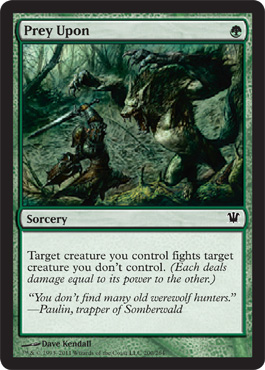
Fight is one of those things that confuse me when they're played against me - I'm never sure about how instants work and damage and healing and where the heck does it count in combat since it's a sorcery that I usually find cast on me after the main combat phase has resolved - but these magic words in the FAQ solved a whole bunch of that

701.10c The damage dealt when a creature fights isn't combat damage.


Oh I see - that's why "fight" is special - it's not combat - it's just a spell effect - with spell damage that happens to be defined by the power of two creatures.

* The damage is dealt simultaneously.

* The amount of damage each creature deals is equal to its power when the spell or ability that instructs the creatures to fight resolves.

* Five older cards will receive updated Oracle wordings to include the new term. (Several cards with similar effects won't be updated. Most of those cards involve potentially more than two creatures dealing damage or damage that is dealt sequentially rather than simultaneously.

So Wizards also knows it's not really a fantastic fit for the legacy cards either - I'm sure some of them thought it was flavorful or something - they're very enamored with themselves that way not realizing how arbitrary it looks when you're learning.

Ok - Cool. I learned something that clarified things maybe I should just read the FAQs! After all it won't be loaded with a whole bunch of other agendas it will just answer things they knew in advance would be confusing - No personalities, no matches or rankings or boosters or egos on the line - WooT!

Great what else can I learn? Well right underneath it is a dual land called Hinterland Harbor

Hinterland Harbor
Land
Hinterland Harbor enters the battlefield tapped unless you control a Forest or an Island.
Tap: Add Green Mana or Blue Mana to your mana pool.

  • These lands check for lands you control with either of the two listed land types, not either of the two listed names. The lands they check for don't have to be basic lands. For example, if you control Stomping Ground (a nonbasic land with the land types Mountain and Forest), Hinterland Harbor will enter the battlefield untapped.

  • As these lands are entering the battlefield, they check for lands that are already on the battlefield. They won't see lands that are entering the battlefield at the same time (due to Primeval Titan's ability, for example).


And that was the beginning of me wondering if that " checking for land with the two listed land types" was a common thing - for instance without looking at that FAQ just reading the cards while learning the game I would have assumed if all I had down were other Hinterland Harbors they all would come in tapped because I didn't have an Island or a Forest out.

And does that mean that Avacyn's Pilgrims or Llanowar elves count as Forests or Plains? Was it even a consistent rule for powerups? The answer wasn't really in the Innistrad FAQ it was in the Magic 2012 where another dual land used almost the exact same wording to describe the search. But the power up question was answered by Dungrove Elder


Dungrove Elder
2 Mana Green Mana
Creature -- Treefolk
*/*
Hexproof (This creature can't be the target of spells or abilities your opponents control.)
Dungrove Elder's power and toughness are each equal to the number of Forests you control.

  • Dungrove Elder's power and toughness are each equal to the number of lands you control with the land type Forest, not necessarily lands named Forest.

  • Dungrove Elder's power and toughness will change as the number of Forests you control changes.

  • Dungrove Elder's ability sets its power and toughness in all zones, not just the battlefield.

You see that part where it says "lands you control with the land type Forest, not necessarily lands named Forest." ?

When I was an RPGA judge we used to call a forced block of required text "boxed text". It usually was the thing that you needed to do to keep the game somewhere withing the timeframe or the tournament rules. That statement right there reads like box text, something created to be reusued in multiple situations regardless of how crazy those situations could get.

So far it looks like it might just be Lands that get this interpretation there are no "landwalk" cards in Innistrad but I knew there were in 2012 Core set so I looked to find if there was an FAQ version - this interpretation of the mechanic was going to be relevant. Found one - Harbor Serpent


Harbor Serpent
4 Mana Blue Mana Blue Mana
Creature -- Serpent
5/5
Islandwalk (This creature is unblockable as long as defending player controls an Island.)
Harbor Serpent can't attack unless there are five or more Islands on the battlefield.

  • Harbor Serpent's abilities care about lands with the land type Island, not necessarily lands named Island.

  • The second ability checks how many Islands are on the battlefield (regardless of who controls them) only as attackers are declared. Once Harbor Serpent is declared as an attacker, it will continue to attack even if the number of Islands on the battlefield falls below five.


Box text? Check. A slight variation but it's still "land types" vs "Island".


It was the only "walk" I found though.


I learned other little tidbits - Like Blood Seeker has a note "Life loss is not the same as damage. Blood Seeker's ability will not cause creatures with bloodthirst to enter the battlefield with +1/+1 counters. "


And I learned this from Elvish Archdruid "Elvish Archdruid's activated ability is a mana ability. It doesn't use the stack and players can't respond to it." Which tells me something about stacks, timin and mana abilities but I'm not fully sure I know exactly what yet.


But here, here is the little gem buried in the Ice Cage FAQ that finally allows me to understand what the FARK was going on with the mana leak/illusion question - why this isn't in the standard text explaining illusions is beyond me since it makes things so clear for Ice Cage


Ice Cage
1 Mana Blue Mana
Enchantment -- Aura
Enchant creature
Enchanted creature can't attack or block, and its activated abilities can't be activated.
When enchanted creature becomes the target of a spell or ability, destroy Ice Cage.


If the enchanted creature becomes the target of a spell or ability, Ice Cage's ability triggers and is put on the stack on top of that spell or ability. Ice Cage's ability will resolve (causing Ice Cage to be destroyed) first.

Do you see that? The ability triggers at target and basically floats at the top of the stack so that it resolves regardless of response! So simple, so clear - so much better than any of the nonsense about what makes what happen based on two sets of interacting word searches - it's a rule! It's a reusable rule with a clear explanation. Trigger effects float!


Now, this means I am okay with the mana leak/illusion logic now but I think that if you're going to use "land type" instead of "lands named the thing the card text says it's looking for" you should use the circle/symbol instead of the word. It makes it a point of contention and it's not really clear because when you look up the rule

702.13c

A creature with landwalk is unblockable as long as the defending player controls at least one land with the specified subtype (as in "islandwalk"), with the specified supertype (as in "legendary landwalk"), without the specified supertype (as in "nonbasic landwalk"), or with both the specified supertype and the specified subtype (as in "snow swampwalk"). (See rule 509, "Declare Blockers Step.")

This would seem to indicate that nonbasic lands shouldn't count but I could be reading that wrong. I'll pseudocode it later to parse it

But it does also answer the other question about blocking creatures that also have the same landwalk

702.13d Landwalk abilities don't "cancel" one another.

Example: If a player controls a snow Forest, that player can't block an attacking creature with snow forestwalk even if he or she also controls a creature with snow forestwalk

Landwalk abilities don't "cancel" one another.

Example: If a player controls a snow Forest, that player can't block an attacking creature with snow forestwalk even if he or she also controls a creature with snow forestwalk


So Landwalk basically means if you have any land that has the compatible symbol on it this.creature = unblocakable and the limiting factor is over in the oponent's zone. Primarily it's a conditional evasion ability.

This brings me back to a rant I've been going on and on about in the real life world - which is that "learning from your community" for the slang, the rules, the strategies and tactics isn't really good for newbs. Who do you trust? How do you figure out who's a more reliable teacher, how do you not be really, really embarassed when you stand by a rules point that is flagrantly wrong to find out that "everyone knows" except the person who taught you the rule. (or possibly used it against you incorrectly) during an actual tournament. It's embarassing enough playing kitchen table.

This is why OP "teams" with actually ranked coaches, like the judges would make things much, much better for people who would like to play competitively but get turned off by so many of the barriers to entry - if we had teams with "practices" and coaches who were literally there to make us all consistent players to the best of our ability these things would be caught and corrected and STANDARDIZED before the competitive experience made it all worse and overwhelming. Your FNM opponent might be a nice guy but a bad teacher and more importantly he's there to win, not teach. He might want other people to play the game and be a spokesperson for it but there's no way for him to be able to raech out and make it accessible without some kind of actual support from Wizards or the LGS itself.

If Wizards and the DCI want to expand the OP base they really should look into a coaching program - I believe I shall flog this particular horse until someone hears me : )

* Hey look at that Magic Writers on blogs; I can use the full wording of a common slang acronym in parenthesis right afterwards once and all it does is let people know what I'm talking about if they stumble in from nowhere . . . you know just like they do in science abstracts, all government documents, every MLA formatted essay you had to write in school . . . . it's not so hard to be inclusive. I do realize that none of you will ever see this but I feel better now.

Thursday, November 10, 2011

First Draft Event

Last night I went to my local store to either watch or participate in my first draft.

Preparation - I read several articles about signaling and how draft works and played with the widget that Wizards of the Coast provided.

Comfort Level - none - while I'm a little more confident about limited, draft requires you to find cards, keep a strategy in mind, build the deck based on your picks AND if you can strategically hate pick *(I hate the fact that I'm using slang already without defining it and I promise that after this entry is out of the way I'll either come back and make it better but these are notes I need to get here first - better intro after I've updated my regular blog)

Why I decided to enter: It might be the only open Monday or Wednesday night for the next few months, it looked like there might not be an even amount of players, and I will not get better if I don't play.

Results - I will also update this with the actual cards later but for right now
Unlike my other 1st tournaments I was not just 0-3 I was completely shut out. The good part is I was able to figure out what I was doing wrong and the weakness of the deck I was putting together the bad part is I couldn't seem to fix it.

Take- Aways
The first round I had a real problem with shuffling and the distribution of cards and land was not randomized. There are two things I can improve on - either making sure I have more buffer between shuffling and game start or asking not to move so fast so I can shuffle sufficiently 7 card pile twice and at least 3 bridge shuffles.

The second round I should have mulliganed when I was land heavy and didn't because I was worried about not pulling creatures.

I had a card that I kept looking at as though it was a sorcery but it was really a defender.

Rules we called a judge over for - damage resolution on a tap effect used as an instant - specifically tapping an attacking creature to prevent activation - of a battle effect. Not remembering the specific cards this next morning is the reason I'm starting this journal. I was trying to prevent an action with Feeling of Dread - but it ended up that the ability activated anyway.

I took advantage of the sideboard and switched two forests for creatures.

Third round - was most upset with myself for this round - I lost my temper through no fault of the person I was playing -he used a tap card on me to stop a declared attack on voiceless spirit with a trepanation blade. I know WotTC hated the word "interrupt" being different than instant but the reality is that sometime it would make things clearer. I should have just asked for a judge but in retrospect there were two problems - problem one is that I am not yet in the habit of announcing "attack phase" before declaring attackers so his response after I tapped an attacking creature could be considered a "rush" and the fact of the matter is I reacted by interrupting him saying "no" while he was trying to use "Feeling of Dread" because I had specifically had that card ruled against that usage in round two. When I realized I was reacting overemotionally due to frustration, overtiredness and the fact that I was still unable to break through my uncertainty about strategic timing in using some of the cards in my deck I walked back and let him have everything . It wouldn't have mattered to the game if I had been either correct or the play he made revoked, I lost focus, I wasn't in control of myself or the board and I knew that calling the judge over would resolve the rules question but it wouldn't help get me back to either focus or rationalism. It was more important that I disciplined myself rather than resolve the question.

This is the third time that I have competed and felt a physical toll in the last round ( but the first time it showed up as crankiness) I do not want to be THAT player.

End result - you can use Feeling of Dread to stop an attack by tapping the creatures it targets before they are declared as attackers but not after they have been tapped by their controller - so technically he was wrong, but in tournament rules I might have been considered "rushing" by not specifically saying I was moving into attack phase. This confusion ( since I had tapped the spirit) led to the seriously cranky part where I though the Trepanation Blade triggered ( which it would have if I had attacked). I should have asked for a judge but calmly, instead the lesson learned is that I'm going to have to practice announcing phases.

This post is the starting point for the blog/journal in a real sense I need to keep track of these things with words I understand instead of all the jargon that the forums are full of and centralize my references and resources. Origin stories next I guess.